
How to Choose the Best Ecommerce Support Services
August 15, 2026
How to Fix Broken Website Pages for Your Business
August 19, 2026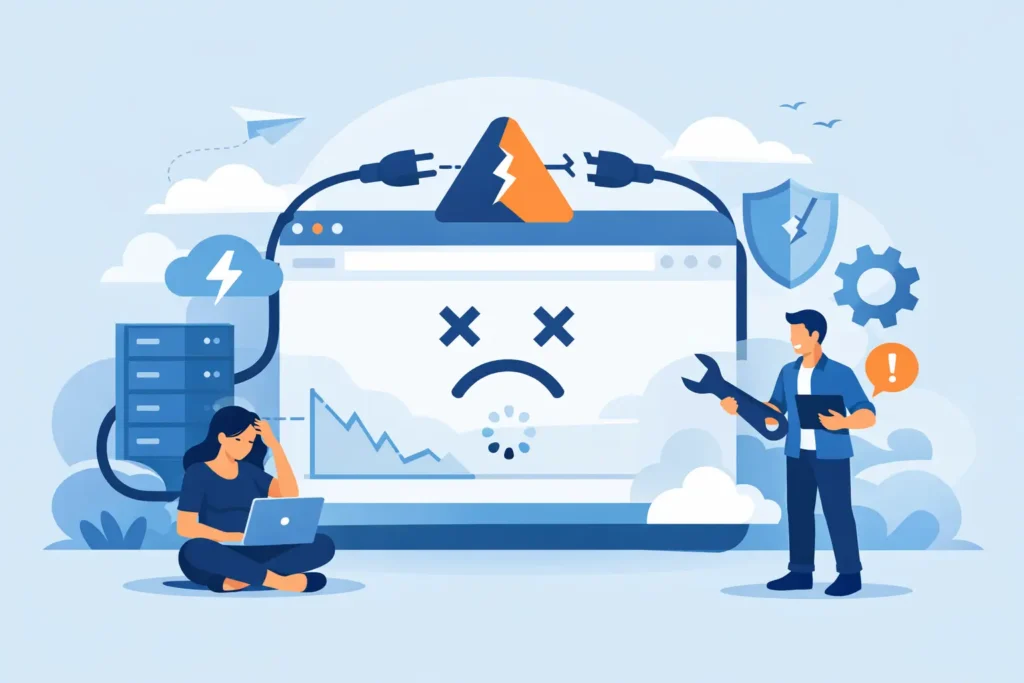
A website can stop working at the worst possible moment: when a customer is checking your opening times, sending an enquiry or trying to make a purchase. Understanding why websites go offline helps you avoid treating every outage as a mystery. Most problems have a clear cause, and many can be prevented with regular care.
For a small business, a website outage is not just a technical inconvenience. It can mean missed calls, lost orders, damaged confidence and time taken away from running the business. The good news is that keeping a site online does not usually require you to become technical. It requires the right checks to happen before a small issue becomes a visible problem.
Why websites go offline in the first place
A website depends on several services working together. Your domain name must point to the right place, your hosting account must be active, the server must be available, and the website software must run properly. If one of these parts fails, visitors may see an error message, a blank page or nothing at all.
Some outages are caused by problems outside your direct control, such as a fault at the hosting provider or a wider internet service disruption. These are less common, but they do happen. More often, the cause is something that has been missed: an expired renewal, an out-of-date plugin, a failed update or a website that has been compromised.
The difference matters. A provider issue may need monitoring while it is fixed. A preventable issue needs a process that makes sure it is spotted earlier next time.
Domain name expiry
Your domain is the address customers type into their browser. If it expires, your website and business email can stop working, even if the website itself is still safely stored on a server.
This can happen when renewal reminders go to an old email address, a card has expired, or a former employee or web supplier controls the account. Domain renewals are simple, but they are easy to overlook when nobody has clear responsibility for them.
Keep the domain account in a business-controlled email address, check that renewal details are current and turn on automatic renewal where appropriate. It is also worth knowing who has access to the account before there is an urgent problem.
Hosting failures and account issues
Hosting is where your website files, database and email services may be stored. A hosting server can suffer a technical fault, but an account can also be suspended because of an unpaid invoice, exceeded storage limits or a security concern.
Cheap hosting is not always bad hosting, but the lowest-cost option can come with limited support, crowded servers and slower responses when something goes wrong. For a brochure website with modest traffic, this may be an acceptable trade-off. For a site that brings in regular enquiries or sales, reliable support and sensible backups are usually worth more than saving a few pounds a year.
A hosting issue should be diagnosed properly. Moving a website to another host without checking the real cause can create additional disruption and may not solve the original problem.
Software updates that clash
Many small business websites use WordPress or another content management system. These platforms are useful because content can be updated without rebuilding the site, but they also rely on themes, plugins and core software that need maintaining.
Updates close security gaps and improve compatibility. However, an update can occasionally conflict with an older plugin, a custom feature or the version of PHP running on the server. The result may be a broken page, a checkout that no longer works or a complete website error.
That does not mean updates should be avoided. Leaving software untouched for months creates a larger risk. The sensible approach is to take a backup first, apply updates in a controlled way and test the important parts of the site afterwards. On an e-commerce site, that includes the basket, checkout, payment process and order emails.
Hacking, malware and unwanted changes
Outdated software, weak passwords and unused administrator accounts can give attackers a way into a website. Sometimes the signs are obvious: visitors are redirected to another site, warning messages appear in search results or the hosting company suspends the account. In other cases, the problem sits quietly in the background, sending spam or using server resources until the site becomes slow or unavailable.
Small businesses are not too small to be targeted. Automated attacks look for known weaknesses, not famous brands. A website that has not been maintained can be found and exploited just as easily as a larger one.
Good security is mostly consistent housekeeping. Use unique, strong passwords, remove accounts that are no longer needed, keep software current and retain clean backups. If a site is compromised, restoring a known-good backup may be faster than trying to repair every damaged file, but the entry point still needs to be closed.
Traffic spikes and performance problems
A sudden increase in visitors can be good news, but it can put pressure on an underpowered hosting plan. This may happen after a successful social media post, a local press mention, a seasonal offer or a marketing campaign. If the server cannot handle the demand, the site may slow down or return errors.
Not every performance problem is caused by high visitor numbers. Large unoptimised images, poorly configured plugins, old code and a bloated database can all make a site harder for a server to handle. A website may appear fine on a quiet Tuesday morning but struggle when several people use it at once.
The right hosting level depends on the website. A simple site for a local service business has different needs from a busy online shop. Regular performance checks help you make a sensible decision before customers start encountering problems.
The hidden cost of leaving a website unattended
When a site is offline for a few minutes overnight, the practical impact may be small. When it is down during trading hours, the cost can be more serious. A prospective customer may not try again. They may call a competitor whose website is working.
There is also the cost of uncertainty. Business owners can lose hours trying passwords, searching forums and messaging an old developer who may no longer be available. Meanwhile, staff may be unable to update the site, access forms or confirm online orders.
Longer outages can affect search visibility too. Search engines expect sites to be available and trustworthy. One short interruption will not normally undo years of work, but repeated errors, hacked pages or prolonged downtime can weaken your online presence over time.
Practical checks that keep a website available
The aim is not to watch your website every hour. It is to make sure somebody is responsible for the essentials and can act when something needs attention.
A useful maintenance routine covers the following areas:
- Domain and hosting renewal dates, account access and payment details.
- Regular backups stored safely and checked so they can actually be restored.
- Core software, theme and plugin updates, applied with testing rather than guesswork.
- Security monitoring, strong user access controls and removal of unused accounts.
- Checks of contact forms, email delivery, key pages, site speed and, where relevant, the online checkout.
The frequency depends on the website. A site with online payments, frequent content changes or customer data needs closer attention than a simple five-page site. Even a basic website, though, should not be left untouched for a year. Domain renewals, security updates and backups still matter.
What to do when your website is already down
First, check whether the problem affects everyone or only your own device. Try another browser, a mobile connection or an online colleague. If the site is genuinely unavailable, avoid making rushed changes to files, DNS settings or passwords unless you know exactly what has happened. Well-meant changes can make recovery harder.
Check recent events next. Has a domain or hosting invoice been missed? Was an update made shortly before the problem appeared? Has the host sent a security notice? These details give a support provider a much better starting point.
If your business depends on online enquiries or sales, communicate clearly while the issue is being resolved. Update social channels if suitable, make sure your phone number is visible elsewhere, and tell existing customers how to reach you. The priority is restoring the site safely, not simply getting any version of it back online.
Website care is business continuity
A website is often treated as a project that ends at launch. In reality, it is a working part of the business. It needs renewing, updating, checking and protecting in the same way as other essential business systems.
For busy owners, ongoing support removes the need to remember every renewal date or investigate every technical warning. My Website Needs Help provides practical website care so that small businesses can keep their sites working, updated and protected without carrying the burden themselves.
A well-maintained website will not prevent every external outage. It will, however, greatly reduce avoidable disruption and ensure that when a problem does occur, someone can deal with it quickly and sensibly. That is the reassurance a business website should provide: it is there when customers need it.